October 2025

Deployment Guide for High Precision PTP Network Architecture

The purpose of this document is to provide network and system administrators with a macro-guide to a high-precision PTP (Precision Time Protocol) network architecture. We will present a hierarchical, scalable PTP synchronization model that consists of three core levels of devices: the PTP Master Clock (Grandmaster), the PTP Boundary Clock, and the PTP Slave Clock.

Deployment Guide for High Precision PTP Network Architecture Read More "
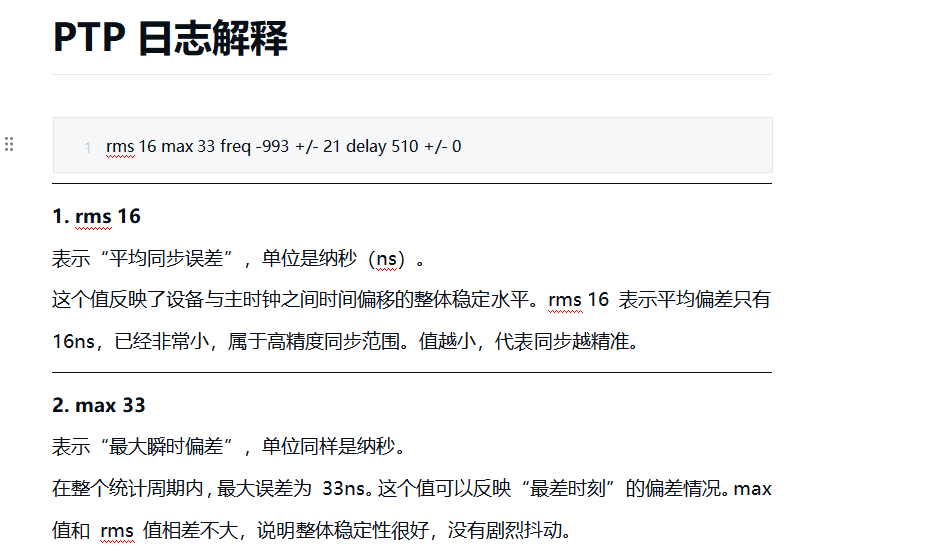
PTP Log Interpretation

rms 16
Indicates the "average synchronization error" in nanoseconds (ns).
This value reflects the overall level of stability of the time offset between the device and the master clock. rms 16 means that the average deviation is only 16ns, which is already very small and falls within the range of high-precision synchronization. The smaller the value, the more accurate the synchronization.

PTP Log Interpretation Read More "

T830 Clock Server PTP Pre-sales Program for Financial Industry

In a financial production network, time is not "as close as possible", but "must be consistent and traceable". When relying only on NTP, queuing jitter and path asymmetry across three layers and congestion can magnify deviations and tail risks to the millisecond-microsecond scale; PTP transforms source-to-end errors from uncontrollable fluctuations to budgetable, attributable, and manageable ones through hardware timestamps on the NIC/switching chip, boundary/transparent clocks, and (optionally) SyncE. PTP turns "source-network" errors from uncontrollable fluctuations into budgetable, attributable, and auditable quantities of work through hardware timestamps on NICs/switch chipsets and (optional) SyncE.

T830 Clock Server PTP Pre-sales Program for Financial Industry Read More "

Financial Clock System Compliance Technology Program and Regulatory Benchmarking Report

This content is intended to serve as a reference for financial institutions, regulators and technology service providers in building time synchronization compliance. With the increasing frequency of global financial transactions, time has become an important infrastructure to ensure market fairness and compliance. Based on the regulatory standards of five global jurisdictions and domestic and international time system construction experience, this document systematically describes the technical architecture, regulatory requirements and compliance implementation path of time synchronization in the financial industry.

Financial Clock System Compliance Technology Program and Regulatory Benchmarking Report Read More "

滚动至顶部